
AI-Guided Hit Discovery for Small-Molecule Drug Discovery
Synfini translates validated targets into confirmed hit classes by connecting AI hit generation, synthesis-aware chemical space exploration, automated chemistry, and biological testing in one place.
Tell us about your target, available data, and assays.
What Is Hit Discovery in Drug Discovery?
Hit discovery is the stage of the drug discovery process where researchers identify compounds with activity against a target and validate the most promising chemical classes experimentally.
It provides confirmed lead identification as a starting point for hit-to-lead and lead optimization.
Where Hit Discovery Loses Time
Hits can be discovered from high-throughput or DEL screening or through AI-driven virtual screening. Experimental methods screen millions to billions of compounds, but many initial hits fail during confirmation. AI can search much larger chemical space and propose millions of compounds as hits, but that only shifts the bottleneck to making and testing enough of them to identify meaningful starting points.
Progress slows when modeling, compound selection, synthesis, and biological testing sit with different teams and information waits at each handoff.
How Synfini Finds and Validates Hits
Target-specific AI, synthesis planning, automated chemistry, and biological screening are integrated in Synfini’s Agile Chemistry Foundry, so computational predictions can be tested rapidly as physical compounds.
DesignSynDesign
Models built for your target
Build predictive models from literature, public datasets and your proprietary data. Generate and score compounds for predicted potency, selectivity, and ADMET properties.
Synthesis-aware chemical space searching and enumeration focus design on diverse compounds with practical routes. Docking or co-folding can further assess prioritized compounds and their potential target interactions.
MakeSynRoute + SynBuild
Virtual hits become physical compounds
Prioritized compounds are purchased when available or produced by high-throughput microscale synthesis with integrated purification to maximize data quality in biological testing. Route planning and automated library synthesis make it practical to test novel compounds and multiple hit classes in parallel.
TestYour assays
Hits confirmed experimentally
Compounds move into biological testing to confirm activity and eliminate false positives. Direct-to-biology screening connects microscale synthesis with rapid assay results, while selected hits are scaled up for advanced multiparameter testing.
AnalyzeSynPlan + SynDB
Hit validation through SAR expansion
Confirmed hits undergo hit explosion through focused library synthesis and screening. Preliminary structure–activity relationships identify which chemical classes are optimizable and have the strongest potential for hit-to-lead and lead discovery.
What You Bring and What We Run
Synfini can start from a validated target, published compounds, structural data, screening results, or proprietary assay data.
You bring
- A validated target protein
- Any existing hits, model compounds and data
- Your assays and hit criteria
Synfini runs
- Target-specific model building and AI hit generation
- Synthesis-aware searching, route planning, and compound production
- Hit validation, library synthesis, and preliminary SAR analysis
Step 1A conversation about your target and available data
Step 2A hit discovery plan built around your assays and validation criteria
Step 3Generate, make, and test compounds until validated hit classes are ready for hit-to-lead
A GPCR Collaboration Target Case Study
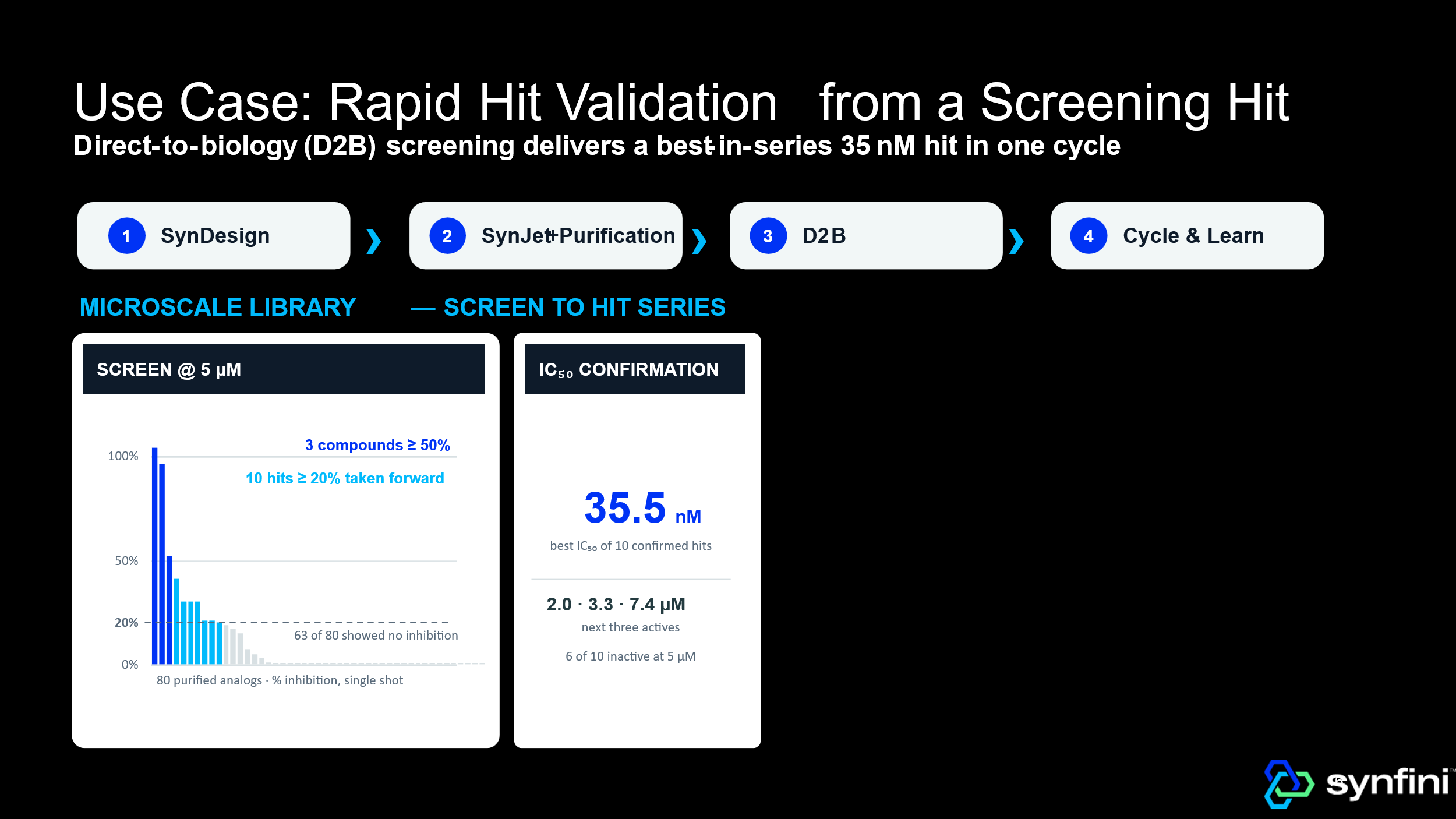
Starting from a 0.5 µM screening hit with no close commercial analogs, Synfini designed and synthesized an 80-compound microscale library to explore the surrounding chemical space. An initial single-point assay rapidly identified active compounds, with the 10 most promising compounds advanced to full dose-response testing.
The results validated a tractable hit class with clear, optimizable SAR and lead identification of a 35 nM active compound, all in a single DMTA cycle.
AI-Guided Hit Discovery vs. High-Throughput Screening
The two methods can work together. The difference is how compounds are selected and converted into validated hit classes.
| High throughput screening | Synfini | |
|---|---|---|
| Starting point | A large physical compound library | Your target, literature, structural information, and available data |
| Compounds selected by | Library availability and screening results | Target-specific models, synthesis-aware AI, and multiparameter scoring |
| What you get | Initial hits requiring confirmation | Validated hit classes with preliminary SAR and synthesis routes |
Who This Is For
Pharma, biotech and research institutes that need validated chemical starting points for novel targets wanting accelerated drug discovery through AI design and robotic synthesis and testing in automated DMTA cycles.
A target, no hits yet
You want to generate promising compounds without relying on a large conventional screening campaign.
Predicted or screening hits
You need to confirm activity, exclude false positives, and determine which chemical classes are worth pursuing.
A lead decision ahead
You need hit explosion, library synthesis, and preliminary SAR to choose which classes move into lead discovery.
Frequently Asked Questions
What is hit discovery in drug discovery?
Hit discovery identifies compounds with measurable activity against a biological target. Compounds may be found through physical screening, virtual screening, literature searching, structure-based design, or AI hit generation.
What is the difference between hit discovery and hit validation?
Hit discovery generates or identifies potentially active compounds. Hit validation confirms that activity is reproducible and establishes whether a compound represents a credible, expandable chemical class.
How does AI support hit discovery?
SynDesign builds target-specific models from literature and proprietary data, generates or enumerates compounds, and scores them for predicted potency, selectivity, ADMET properties, and synthetic accessibility.
How does high-throughput screening fit into hit discovery?
High-throughput and DEL screening search physical compound collections for activity. Synfini can complement screening data to confirm and validate hits, or generate AI models to search more chemical space around the initial hits to identify new chemical hit classes.
What is library synthesis?
Library synthesis produces related compounds around a common scaffold or design hypothesis. Testing these analogs helps confirm the hit class and establish preliminary structure–activity relationships.
When does a hit move to lead discovery?
A hit class can move into hit-to-lead and lead optimization when its activity is confirmed, the compounds can be synthesized reliably, and preliminary SAR indicates that potency, selectivity, and ADMET properties can be improved.
Find and Validate Hits for Your Target
Learn how Synfini can move your program from a validated target to experimentally confirmed hit classes ready for lead discovery. A member of our team will reply within one business day.
Prefer email? info@synfini.com