
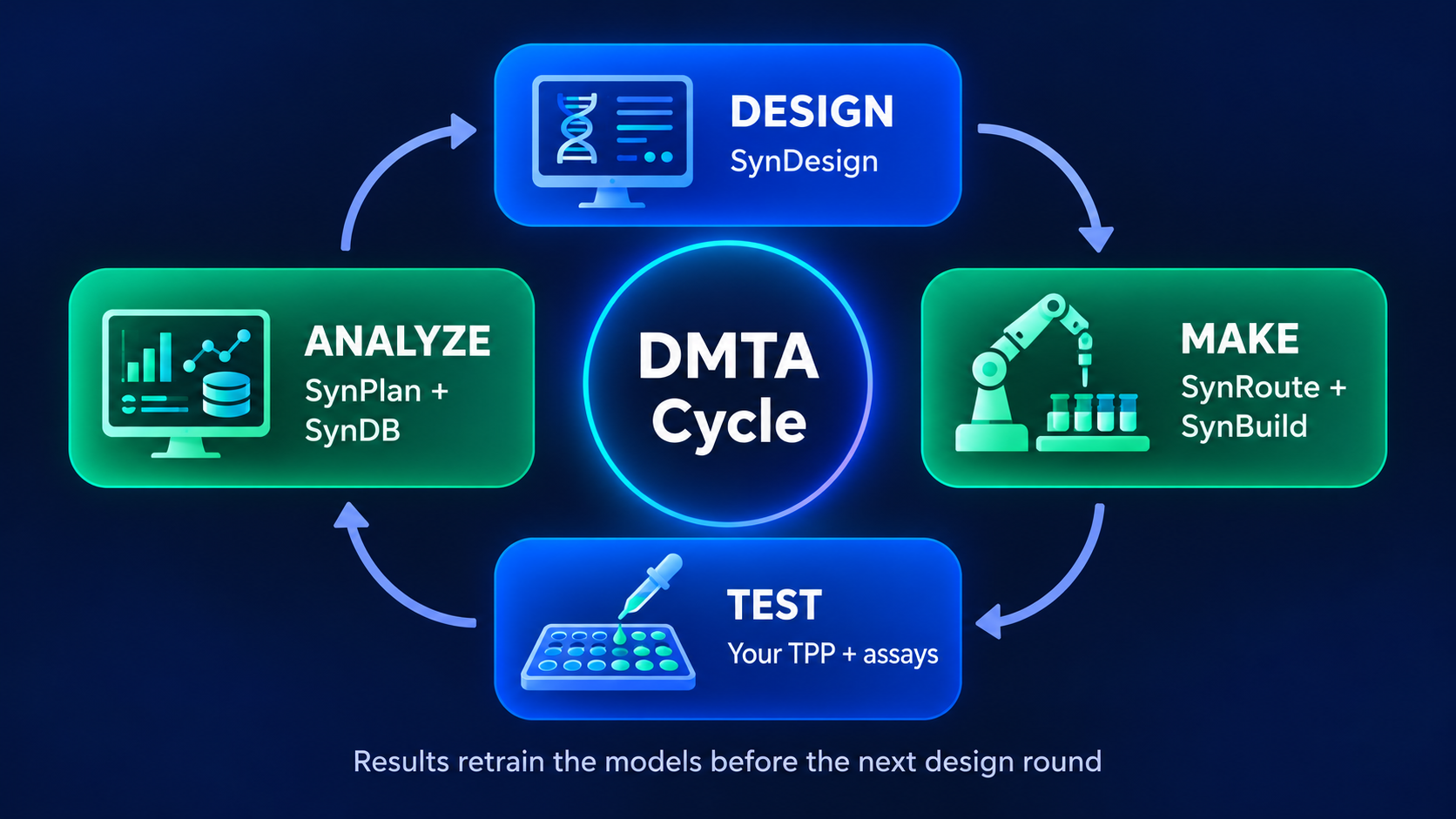
The DMTA cycle sets the pace of drug discovery. DMTA stands for design, make, test, analyze: a team proposes molecules, synthesizes them, measures them in assays, and uses the results to decide what to design next. Drug development typically takes 10 to 15 years, and about four of those years are spent in preclinical discovery, where this loop runs over and over. Published estimates of the cost to develop a single drug range from $161 million to $4.54 billion.
Shortening each pass through the loop is one of the few levers a discovery team controls directly. Teams that cut a cycle from months to weeks get more chances to learn per quarter, and they reach a go or no-go decision on their drug candidates sooner.
What Is the DMTA Cycle in Drug Discovery?
A DMTA cycle is an iterative process that takes a set of molecules from idea to data to the next decision. Each pass asks a narrow question, such as whether a change to one part of a scaffold improved potency without costing selectivity or metabolic stability. The answer feeds the next round of design.
Two numbers set the schedule: how many cycles a project needs and how long each one takes. A lead optimization program that needs eight cycles at six weeks each runs for roughly 11 months. The same eight cycles at two weeks each finish in under four months. The chemistry is identical in both cases; only the calendar differs.
The cycle also gives project managers their decision points. At the end of each pass, the team compares results with the target product profile and chooses to continue, change direction, or stop. Because chemists, biologists, and computational scientists all work from the same results, the cycle keeps those groups coordinated. When data stays visible across the loop, teams avoid a common source of waste: two people synthesizing the same compound because neither could see the other’s queue.
Efficiency in this setting means more than speed. It covers how many compounds a team has to make for each useful insight, how much of each cycle is spent waiting, and how well the results from one pass inform the next. Improvements in any one of these can accelerate a program, but only the ones that shorten the full loop change the calendar.
Design Make Test Analyze: The Four Stages
The four stages of design make test analyze each have a different owner and a different bottleneck.
Design is where medicinal chemists and computational scientists decide which molecules to make next. They draw on structure-activity relationships from earlier rounds, predictive models, docking, and increasingly on generative AI tools that propose optimized target compounds. A good design set balances potency, selectivity, and absorption and safety profiles, and it has to be something a chemist can actually make.
Make is synthesis. A new chemical entity typically takes at least three reaction steps, and each step brings its own conditions, purification, and chances to fail. Compounds then have to be prepared in sufficient purity and quantity for the assay.
Test sends those compounds into biochemical or cell-based assays. In-house testing at a large company typically takes about one week, and testing at an outside partner adds shipping and queue time. Heavy reliance on cell-based assays lengthens the stage further, because they take longer to run and vary more from batch to batch.
Analyze turns raw results into a decision. The team looks for structure-activity patterns, compares each compound against the target profile, and picks the next design set. This is where the learning happens, and it only works when assay data arrives in a standard form that design tools can read without manual rework.
Make Test Analyze DMTA: Where Cycle Time Goes
A make test analyze DMTA loop usually loses more time between stages than inside them. A synthesis step might need two days at the bench but wait a week for a route to be agreed, reagents to arrive, or an instrument to free up. Purified compounds then ship to a testing site, wait in the assay queue, and come back as a spreadsheet someone has to reformat before the design team can use it. Add a hard design problem, and a single DMTA cycle can stretch to months.
The type of molecule adds to the load. In May 2026 the FDA approved vepdegestrant, a PROTAC protein degrader. PROTACs are bifunctional molecules, typically larger than a classic small molecule and often slower to synthesize, so programs in that area feel the weight of the Make stage more than most.
This is why cycle-time reduction is a major measure of success for DMTA projects. A team that speeds up one stage and leaves the handoffs alone sees little change in the total, because the impact of a faster stage disappears into the queue that follows it. The gains come from removing waits: synthesis that starts as soon as a design is approved, purification that feeds directly into testing, and results that flow back into the design tools without a manual step.
Hit Discovery: Where the First Cycles Start
Hit discovery is where most programs first run the cycle. A team starts with a target and a very large virtual chemical space, picks a small set of molecules, and tests them to find compounds with real activity.
Which molecules go into each pass matters more than it first appears. A 2026 study in the Journal of Chemical Information and Modeling introduced SimDMTA, a simulation of the cycle that uses docking scores in place of assay results, so selection strategies can be compared without running real experiments. A machine learning model predicted scores, chose the next compounds, and retrained on the new data. Selecting the compounds the model was least certain about found more hits than always taking the top predictions, and it produced a better model along the way. By the final iteration, 37 of the model’s top 50 ranked compounds sat within the top 1 percent of the chemical space evaluated.
Because the study used docking scores rather than lab data, it shows how selection strategies behave, not what a wet lab will return. It still supports a practical point: choose each batch so the model learns from it, because the next cycle’s selections are only as good as the model that makes them.
Predictive Models and Machine Learning in the DMTA Cycle
Machine learning enters the DMTA cycle mainly at the Design and Analyze stages. Predictive models estimate properties that matter for a drug candidate, such as potency against a target, solubility, metabolic stability, and off-target activity, so a team can rank thousands of virtual molecules before anyone picks up a flask. Generative AI tools go a step further and propose new molecules and optimize them against several of those properties at once.
The benefit shows up as fewer wasted experiments and fewer cycles. A model that screens out compounds likely to fail on stability or selectivity lets chemists spend their synthesis capacity on molecules with a real chance.
Models have limits. They learn from the data they are given, so a model trained only on public bioactivity data may fail to predict what matters for a new chemical series. Accuracy also depends on feedback: every compound that gets made and tested produces results that can retrain the model. A platform that captures those results automatically keeps its models current, while a workflow that leaves them in emailed spreadsheets lets the models go stale.
Predicting activity for a novel scaffold is challenging, and model performance often drops outside the training data. Careful analysis of the predictions that missed is as useful as analysis of the ones that hit, because the misses show where the model needs more data. Teams can enhance a model’s effectiveness by deliberately testing a few compounds it is unsure about, since the results obtained from those compounds teach it the most.
A strong model attached to a slow Make stage still produces a slow cycle.
Why Docking Scores Alone Do Not Close the Loop
Docking scores estimate how well a molecule fits into a protein’s binding site. They are fast and inexpensive to compute, which makes them useful for triaging large virtual libraries at the Design stage. Researchers also use them as a stand-in for assay data, as SimDMTA does, when real experiments would be too slow or costly for testing new methods.
A docking score is still a model of binding, and binding is one property among many. It says little about whether a compound will be selective, soluble, stable in liver microsomes, or able to cross a cell membrane. It says nothing about whether a chemist can make the molecule.
Teams get more from docking scores when they treat them as one input to a ranking, alongside other predicted properties and an honest estimate of how hard each molecule is to build. That last input is the one most often missing, and it is the subject of the next section.
Synthetic Accessibility vs. Synthetic Feasibility
Synthetic accessibility and synthetic feasibility sound interchangeable, but they answer different questions.
Synthetic accessibility is a property of the structure on the page. Scores such as the SAscore, introduced by Ertl and Schuffenhauer in 2009, estimate how hard a molecule is to make from its fragments and ring systems, on a scale from 1 (easy) to 10 (hard). The calculation takes milliseconds and needs no route, which makes it a good first filter for a large generated library.
Synthetic feasibility is a property of a real attempt. It asks whether a route exists that a specific lab can run: whether suitable building blocks are in stock, whether each reaction has conditions that work on this substrate, how many steps are required, and whether the product can be purified at the scale the assay needs. A molecule can score well on accessibility and still be infeasible this month if one intermediate has a six-week lead time.
The distinction matters more as innovation in generative design continues. AI tools can now produce virtual molecules faster than most labs can synthesize them, so synthesis capacity, not ideas, limits the cycle. Retrosynthesis software helps by proposing routes, but a proposed route is a prediction. The only reliable test of feasibility is running the chemistry and recording what happened.
A practical way to assess feasibility honestly is to filter by accessibility first, check the remaining routes against building block stock, and run the surviving candidates at microscale before committing materials to scale-up. Choose microscale conditions specifically to expose route problems early, since a failed reaction at 10 microliters costs far less than one at gram scale. The results from those runs also tell the next round of design which reactions work.
What Medicinal Chemists Need From a Faster DMTA Cycle
Medicinal chemists own the decisions in a DMTA cycle, and a faster cycle only helps if it leaves those decisions with them. They need to see why a molecule was proposed and what route would make it, so they can reject a design that looks good on paper and fails at the bench. They need every step recorded, from the design rationale to reaction conditions to assay results, because that record supports IP filings and lets a colleague pick up the project. And they need to change direction when the data says so, without waiting for a vendor to retrain a model or a queue to clear.
Tools that rank molecules without showing their reasoning get ignored, and chemists have a direct interest in examining any ranking they are asked to trust. A platform should provide the route, the rationale, and the record together. The questions worth asking of any platform are short: does the chemist set the strategy, can each step be audited, and does data from executed chemistry come back to the design tools? If the answer to all three is yes, the speed gain is likely to hold up in practice.
How Synfini Shortens the DMTA Cycle
Synfini built its Agile Chemistry Foundry on the idea that the four stages should not sit in three different organizations. The platform pairs an open, cloud-based, AI-driven dry lab with a configurable robotic wet lab, so a chemistry team can design a molecule, synthesize it, test it, and analyze the results inside one system. Synfini’s approach is a foundry model that serves its customers. It runs no internal drug pipeline, so it does not compete with the teams that use it.
Each module covers one part of the loop. SynDesign handles generative and SAR-driven molecular design and predicts several properties at once, including from small data sets. SynRoute plans syntheses from the literature and from AI-generated reactions, and it hands routes directly to SynBuild. SynBuild runs the chemistry: SynJet for microscale high-throughput experiments, AutoSyn for flow-based scale-up, and integrated microscale purification. SynDB stores the reaction data, structures, and properties that come out, and it feeds them back to update the models. SynPlan tracks the whole program against the target product profile. The software is based on chemical structure representations, not large language models.
Integration is meant to address the handoffs between vendors, where moving files and reformatting data stalls cycles. Keeping design, synthesis, testing, and analysis in one system lets a team streamline those handoffs, and cloud access means the version of a model trained on last week’s results is the one used to draw the next design set. For a small biotech, this puts big-pharma chemistry within reach: transforming a docking hit into a tested compound no longer requires building a lab.
In February 2026, Synfini added integrated microscale purification to SynBuild. The high-throughput system runs 288 reactions at a time at volumes of 10 to 40 microliters, and purification takes about five minutes per compound. Purified material goes directly into multiplexed bioassays, so a team can move from synthesis to biological testing in hours and skip the multi-day handoff. Because the results go straight into SynDB, synthetic feasibility is measured on reactions that were actually run, not estimated.
Synfini’s published case studies show what this looks like in practice. In a hit discovery project, a SynDesign model trained on 1,359 public bioactivity data points was applied to a preclinical anti-inflammatory target. Of 50 compounds tested, 17 were novel actives, a 34 percent hit rate. In a hit-to-lead project on an anti-inflammatory enzyme target, the team met its goals for potency, selectivity, metabolic stability, and hydrophobicity across four DMTA cycles of 0.5 to 3 weeks each, using 48 compounds in total.
The chemist stays in charge throughout. Every step is traceable, which additionally supports clean IP records, and teams reach robotic automation through the cloud, with no lab to build and no capital investment to make.
Start Your Next DMTA Cycle With Synfini
If your DMTA cycle is measured in months, start by timing the gaps: days from an approved design to the first reaction, from a purified compound to an assay, and from an assay result to the next design set. Those three numbers show which stage to fix first, and the number that ultimately counts is calendar days per cycle. Then talk to Synfini about running your next hit discovery or lead optimization project on the platform.
Sources
- Schlander M, et al. How much does it really cost to develop a new drug? PharmacoEconomics, 2021.
- Williams HJ, Pickett SD, Baxter A, Palmer DS. Query Matters: How Selection Strategies Influence Active Learning in Drug Discovery. Journal of Chemical Information and Modeling, 2026, 66(6), 3288-3301.
- FDA approves vepdegestrant for ESR1-mutated, ER-positive, HER2-negative advanced breast cancer. Targeted Oncology, May 1, 2026.
- Synfini Introduces Integrated Microscale Purification, Delivering Assay-Ready Compounds in Hours Instead of Days. GlobeNewswire, February 9, 2026.